

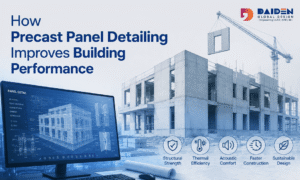
The construction industry is increasingly embracing precast concrete systems as a solution for delivering durable, sustainable, and cost-efficient buildings. From commercial towers and educational campuses to industrial facilities and residential developments, precast panels have become a preferred choice for developers seeking speed, quality, and design flexibility.
However, the true performance of a precast structure depends on more than the panels themselves. Behind every successful precast project lies accurate panel detailing, a critical process that ensures structural reliability, seamless installation, energy efficiency, and long-term durability.
This article explores how high-quality precast panel detailing contributes to superior building performance and why it has become an essential part of modern construction projects.
Understanding the Role of Precast Concrete Panels
Precast concrete panels are manufactured in a controlled factory environment and transported to the construction site for installation. Unlike conventional cast-in-place concrete, precast components are produced with strict quality control measures, resulting in consistent strength, dimensional accuracy, and surface finish.
According to industry studies, precast construction can reduce project timelines by up to 30–50% compared to traditional construction methods because manufacturing and site preparation can occur simultaneously. This accelerated project delivery is one of the primary reasons why developers continue to adopt precast systems for large-scale projects.
Beyond construction speed, precast panels offer:
- High structural strength and durability
- Superior fire resistance
- Reduced maintenance requirements
- Better quality control
- Lower site waste generation
- Enhanced sustainability through optimized material usage
Yet, achieving these benefits requires detailed planning and coordination during the design phase.
What Is Precast Panel Detailing?
Precast panel detailing is the process of creating detailed drawings, connection designs, reinforcement layouts, embeds, lifting systems, and installation information required for manufacturing and erection.
It serves as the bridge between architectural intent, structural engineering requirements, and fabrication processes.
Effective detailing ensures that every panel:
- Fits precisely within the building framework
- Meets structural and safety requirements
- Accommodates mechanical and electrical systems
- Supports thermal and acoustic performance goals
- Facilitates efficient transportation and installation
Without proper detailing, even high-quality precast panels can experience alignment issues, connection failures, installation delays, and performance deficiencies.
1. Strengthening Structural Performance
One of the most significant contributions of precast panel detailing is improved structural integrity.
Buildings are exposed to numerous forces throughout their lifespan, including gravity loads, wind pressure, seismic activity, temperature fluctuations, and dynamic occupancy loads. Proper detailing ensures that these forces are safely transferred throughout the structure.
Detailed reinforcement drawings, connection designs, and load path analysis help engineers:
- Prevent stress concentrations
- Minimize structural movement
- Improve load distribution
- Increase overall building stability
Accurate detailing also ensures that embeds, anchors, and connections are positioned correctly, reducing the risk of installation errors and structural deficiencies.
The result is a building system capable of maintaining its performance for decades with minimal structural maintenance.
2. Enhancing Energy Efficiency
As energy regulations become stricter worldwide, building envelopes play a crucial role in reducing operational costs.
Precast concrete naturally provides thermal mass, which helps regulate indoor temperatures by absorbing and releasing heat gradually. When combined with insulated sandwich panels and properly detailed thermal breaks, precast systems significantly improve energy efficiency.
Detailed panel design helps eliminate thermal bridging at joints and connections, preventing unwanted heat transfer through the building envelope.
Benefits include:
- Reduced heating and cooling loads
- Improved indoor comfort
- Lower energy consumption
- Enhanced building sustainability ratings
For commercial developments, these efficiencies can translate into substantial operational savings over the building’s lifecycle.
3. Supporting Architectural Creativity
Modern architecture demands both functionality and visual appeal. Precast panel detailing enables architects to achieve complex designs without compromising structural performance.
Today’s manufacturing technologies allow precast panels to replicate:
- Natural stone finishes
- Brick textures
- Wood grain appearances
- Custom geometric patterns
- Curved architectural elements
Detailed coordination between architects, engineers, and fabricators ensures that design features, openings, reveals, and decorative elements are incorporated accurately during production.
This level of precision reduces field modifications and helps maintain the architectural vision from concept to completion.
4. Improving Seismic and Wind Resistance
In regions exposed to earthquakes, hurricanes, and high wind loads, connection detailing becomes especially important.
Well-designed precast systems can provide excellent resilience when subjected to lateral forces. The performance of these systems depends heavily on the detailing of joints, reinforcement, and connection hardware.
Advanced detailing allows engineers to:
- Control structural movement
- Improve energy dissipation during seismic events
- Maintain panel stability under extreme wind conditions
- Protect occupants and assets during emergencies
This makes precast construction a reliable solution for critical infrastructure, high-rise developments, and public buildings located in challenging environmental conditions.
5. Delivering Superior Acoustic Performance
Noise control has become a major consideration in residential, healthcare, hospitality, and educational projects.
Concrete’s density naturally provides excellent sound insulation properties. However, proper detailing further enhances acoustic performance by addressing joints, penetrations, and panel interfaces.
Detailed acoustic design helps:
- Reduce airborne noise transmission
- Minimize sound leakage between spaces
- Improve occupant comfort
- Support compliance with building regulations
This creates quieter environments that contribute to productivity, wellbeing, and overall user satisfaction.
6. Increasing Construction Efficiency
Accurate precast panel detailing also plays a major role in project execution.
Detailed shop drawings and coordinated installation plans reduce fabrication errors and improve communication between project stakeholders.
Benefits include:
- Faster manufacturing processes
- Reduced site rework
- Fewer installation conflicts
- Improved crane and lifting planning
- Better project scheduling
Since precast construction relies heavily on precision, comprehensive detailing minimizes costly delays and helps projects remain on schedule.
7. Contributing to Sustainable Construction
Sustainability is no longer optional in modern construction. Detailed precast design supports environmental objectives throughout the project lifecycle.
Factory-controlled manufacturing reduces material waste, while optimized panel designs improve resource efficiency.
Additionally, durable precast systems contribute to sustainability by:
- Extending building lifespan
- Reducing maintenance requirements
- Lowering operational energy consumption
- Supporting green building certification programs
Many developers pursuing sustainable construction strategies now consider precast systems a key component of their environmental goals.
Conclusion
Precast concrete panels deliver far more than structural strength and rapid construction. Their true value is realized when supported by accurate and coordinated detailing.
From improving structural stability and energy efficiency to enhancing seismic resilience, acoustics, sustainability, and architectural quality, precast panel detailing directly influences how a building performs throughout its lifecycle.
As construction projects become increasingly complex, investing in professional precast detailing services is no longer a technical requirement, it is a strategic advantage. By combining engineering precision with manufacturing expertise, project teams can deliver safer, more efficient, and higher-performing buildings that stand the test of time.
Thank you for your reading. Join the conversation by posting a comment.