

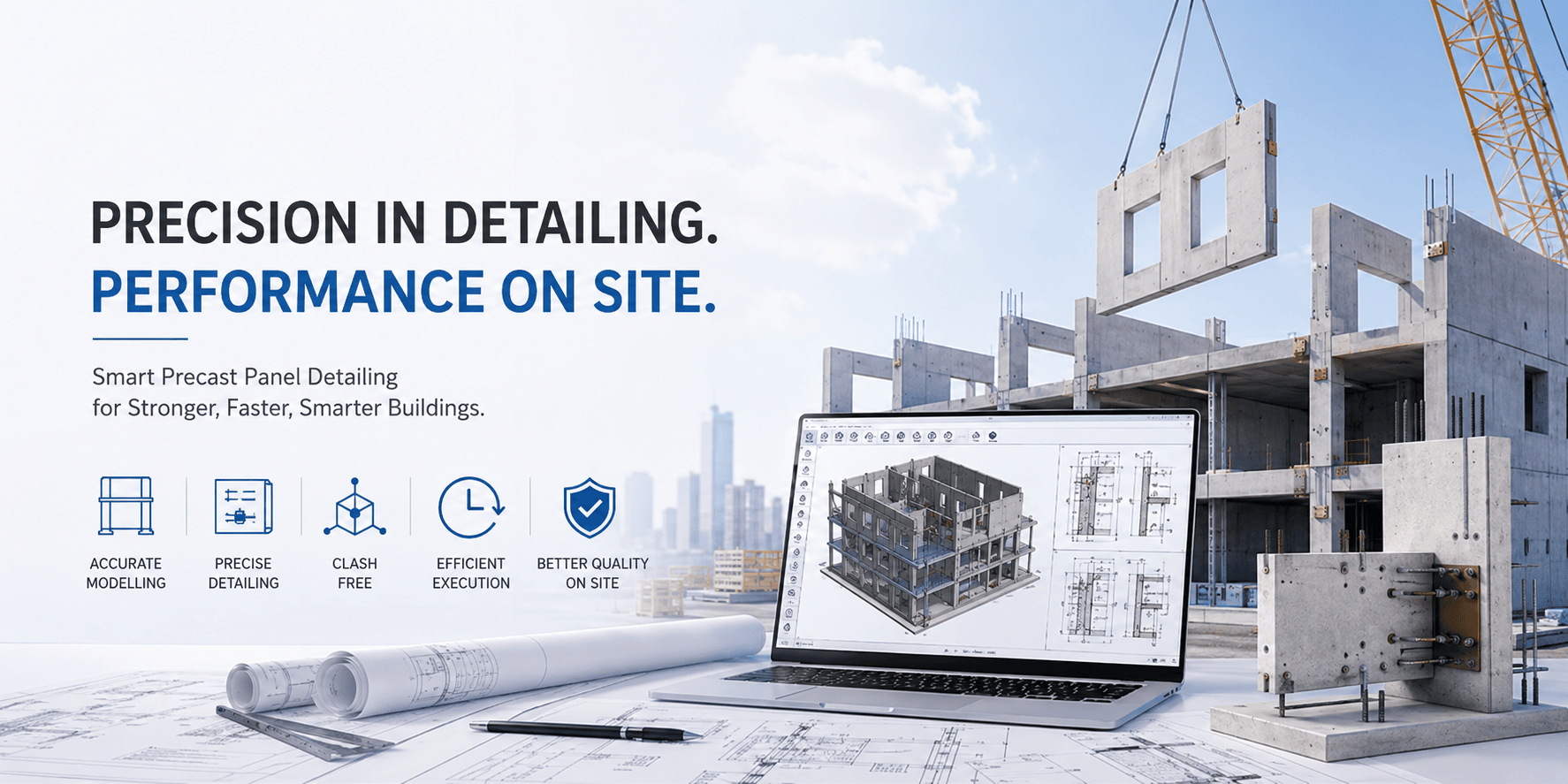
Faster Lifts, Smarter Execution:
In high-density vertical construction, the financial health of a project is increasingly decided by two variables: hook time and field-labor velocity. In precast concrete construction, where multi-ton structural components are fabricated miles away from their final resting place, the margin for error is effectively zero. If a connection plate is misaligned by even a fraction of an inch, an entire erection crew stands idle while an expensive crawler crane sits under load.
A recent structural project we supported serves as a benchmark for how proactive Building Information Modeling (BIM) and highly precise precast detailing directly mitigate these field risks. By shifting structural problem-solving from the chaotic field environment to an ultra-precise digital twin workflow, the project achieved an optimized erection cycle that challenges traditional cast-in-place schedules.
Eliminating the Cumulative Tolerance Tax via BIM
One of the most pervasive challenges in precast engineering is the accumulation of dimensional variances, often referred to as “tolerance stack-up.” While Precast/Prestressed Concrete Institute (PCI) MNL-116 guidelines dictate strict manufacturing tolerances for individual elements, compounding errors during on-site assembly can quickly exceed manageable limits.
On this project, our engineering team combated tolerance stack-up by building a comprehensive, fully coordinated BIM environment. We modeled every structural column, load-bearing spandrel, and intricate floor slab down to the millimeter including reinforcement cages, post-tensioning ducts, architectural reveals, and MEP embeds.
Multi-Disciplinary Clash Mitigation
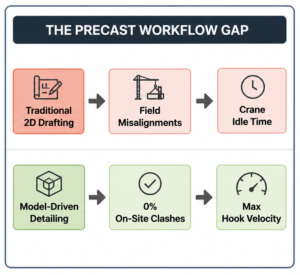
By running automated clash-detection algorithms across architectural structural models and mechanical layouts, we identified and resolved over 120 potential geometric conflicts before a single cubic yard of concrete was poured.
Instead of relying on static 2D shop drawings that often mask spatial overlap, our model-driven detailing ensured that hardware embeds perfectly cleared dense rebar zones. This single source of truth completely eliminated the need for field coring or emergency rebar modification discrepancies that routinely cause field-labor cost overruns.
Deconstructing the Metrics of On-Site Efficiency
To understand the true return on investment (ROI) of precision detailing, one must analyze the specific operational variables managed by erection crews. Our detailing strategy explicitly targeted four critical performance metrics:
1. Optimization of Hook Time and Crane Cycles
Crane rental, mobilization, and labor hook time represent a massive variable cost on any major build site. To maximize daily lift counts, our shop drawings calculated and designated the exact Center of Gravity (CoG) for every custom, non-symmetrical precast element. Rigging crews received precise instructions on the placement of lifting hardware and anchor embeds, allowing them to execute level, predictable lifts right off the flatbed. This minimized the time required for rigging adjustments, cutting average cycle times per lift by an estimated 15%.
2. Elimination of Hot-Work and Field Inventions
When precast elements fail to align, field teams are forced into intrusive interventions: structural grinding, field welding, or mechanical forcing. Our rigorous adherence to dimensional tolerances ensured that components slid cleanly into their designated connections. By eradicating structural re-work, we maintained a zero-incident hot-work environment during erection, avoiding the typical safety hazards and schedule delays associated with emergency field modifications.
3. Connection Geometry and Load Path Integrity
The critical interface of any precast structure lies within its connections the corbels, bearing pads, and welded plates. Our team provided highly detailed, hyper-specific alignment markings and coordinate spacing for every embedment. This granular clarity allowed ironworkers to guide massive elements into place with exceptional spatial accuracy, ensuring that the physical load paths executed on site perfectly matched the theoretical calculations of the structural engineer of record.
4. Compressed Floor-to-Floor Cycle Times
Construction schedules are a series of delicate dependencies. By optimizing the erection cycle, the building envelope was closed ahead of schedule. This rapid structural stabilization created an accelerated hand-off to downstream trades, allowing MEP and interior fit-out contractors to mobilize their crews weeks earlier than initially projected, compounding the project’s overall financial efficiency.
| Operational Metric | Impact of Low-Precision Detail | Impact of High-Precision Detailing |
| Rigging & Lift Prep | Guesswork on CoG; field adjustments | Level, predictable lifts via designated CoG |
| Connection Alignment | Forcing elements; structural grinding | Seamless sliding into connections; 0% hot-work |
| Downstream Trades | Delayed by schedule drift and rework | Early access to site; accelerated dry-in |
Designing for Constructability: The Office-to-Field Feedback Loop
Great detailing does not happen in an intellectual vacuum. A high-performing drafting team must possess an acute awareness of real-world logistics: how a component is stripped from its mold at the plant, how it rides on a flatbed trailer under tight highway clearance limits, and how an ironworker secures it while suspended dozens of feet in the air.
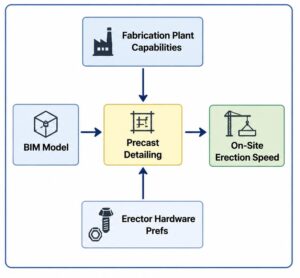
Throughout the pre-construction phase, we maintained open communication channels with the project’s general contractor, fabricators, and erectors. By tailoring our detailing parameters to match the fabricator’s specific bed layouts and the erector’s preferred lifting hardware, we streamlined the Request for Information (RFI) workflow. Rather than serving as passive design records, the resulting shop drawings functioned as highly efficient, field-ready manufacturing manuals.
Value Engineering the Pre-Construction Phase
At Daiden Global Engineering Consultants, we define engineering excellence by the speed and safety of the on-site erection crew. Our philosophy treats precast detailing not merely as a drafting requirement, but as a manufacturing optimization process. By engineering out risk, mitigating tolerance stack-up, and maximizing hook velocity during the design phase, we protect our clients’ bottom lines before the first crane is ever assembled.
As we continue to support complex vertical builds across the country, we remain dedicated to proving that rigorous, model-driven precision in the office guarantees smarter, faster execution in the field.
Thank you for your reading. Join the conversation by posting a comment.