

Why the smartest fabricators have stopped asking “How cheap” &
started asking “How fast, How flexible, How good”
For twenty years, the pitch for outsourcing cast stone detailing was simple and slightly embarrassing: send the drawings to a country where engineers cost less, and pocket the difference. It worked, in the crude way that any labor arbitrage works – right up until the market caught up with it.
Wage gaps between U.S. and offshore drafting talent have compressed steadily over the past decade, and the firms still chasing them are discovering a hard truth: if cost-per-hour is your entire strategy, someone will always undercut you, and you’ll have optimized for the wrong variable. The fabricators actually pulling ahead right now aren’t buying cheap labor. They’re buying capacity on demand – engineering bandwidth that expands and contracts with their bid calendar, follows the sun across time zones, and comes pre-loaded with skills their local labor pool simply doesn’t have enough of.
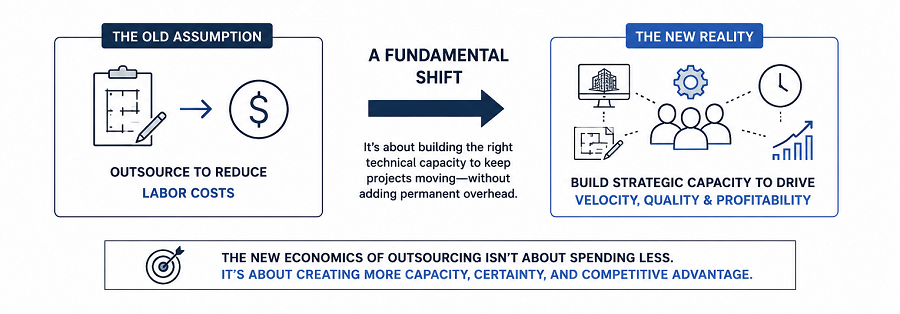
That’s a different business, with different math.
1. The bottleneck was never labor cost – it was labor availability
Cast stone detailing sits in an uncomfortable niche. It’s not quite structural engineering, not quite architectural drafting, not quite mold-making; it’s all three, stitched together by someone who understands how a return, a quoin, a balustrade, or a complex cornice actually gets cast, cured, anchored, and hoisted into a façade without cracking, staining, or fighting the steel behind it.
That combination of skills is genuinely scarce. Most U.S. detailing talent aged into the trade through apprenticeship inside a handful of precast and cast stone plants, and that pipeline has thinned as the industry consolidated. Meanwhile, project intake is lumpy: a fabricator might need four detailers in March for a hospital bid package and one in July. Hiring full-time W-2 staff to cover the peak means carrying dead weight in the trough – the classic feast-and-famine problem that has quietly capped growth at mid-size cast stone shops for a generation.
Outsourcing solved this by accident. The “cheap labor” framing was really always describing elastic capacity, it just wasn’t being measured that way, so nobody managed it that way either.
2. What “strategic capacity” actually looks like on a shop floor
Reframed correctly, an offshore or nearshore detailing partnership isn’t a cost line. It’s a bench. The mechanics that matter:
- Follow-the-sun production cycles. A U.S. detailer marks up redlines at 4 p.m. and hands them to a partner team in India or the Philippines that starts fresh at the beginning of their day. Drawings come back reviewed and revised before the U.S. team is back at their desk the next morning. On a tight submittal schedule – say, a 15,000-square-foot GFRC and cast stone façade package with a three-week shop drawing turnaround, that overlap can compress the review-revise loop from days to hours. It’s not more people; it’s the same people working in parallel across a clock nobody else is using.
- Surge absorption without headcount risk. When a fabricator wins two large bids in the same quarter, a capacity partner scales a team from three detailers to nine inside a week, then back down without a layoff. The internal engineering team stays lean and stable; the variable load lives externally, contractually, where it belongs.
- Skill specialization the local market can’t support. Parametric modeling for double-curved cast stone panels, Grasshopper-driven paneling algorithms for complex façade geometry, Revit families built specifically for anchor and joint standards – these are deep, narrow skill sets. A mid-size U.S. shop can’t justify a full-time employee whose only job is scripting parametric mold geometry. A capacity partner spreads that specialist across a dozen client shops and makes the economics work for everyone.
3. The technical ground has shifted, too
Detailing itself is not the same discipline it was five years ago, and this is where the “cheap labor” narrative really breaks down, you cannot arbitrage your way into capabilities you don’t have.
- Cloud-native BIM coordination (Autodesk Construction Cloud, BIM 360 worksharing) means the offshore team isn’t emailing DWG files back and forth, they’re inside the live model, clash-detecting cast stone anchors against structural steel and curtain wall in real time, alongside the GC’s coordination team. Geography has stopped being a constraint on model access.
- Generative and parametric tooling now handles a meaningful share of profile and mold-geometry generation for repetitive elements, bases, caps, sills, coping, freeing human detailers to spend their attention on the genuinely hard geometry: transitions, returns, and anything with double curvature or non-standard reveal conditions.
- AI-assisted drafting and take-off tools are starting to auto-populate piece drawing schedules and quantity take-offs from a coordinated model, with humans reviewing and correcting rather than drawing from scratch. This is early, accuracy still needs a trained eye, but the trend line is clear: routine drafting work is being compressed, and the value is migrating toward review, judgment, and engineering sign-off.
- LOD discipline is tightening. Owners and GCs increasingly specify Level of Development (LOD 300–400) requirements contractually, which means a detailing partner’s internal QA process, including checklists, standardized anchor libraries, and revision logging has become a procurement criterion, not merely an internal best practice.
None of this is cheaper to do badly. All of it is cheaper to do well, at scale, with a partner who has already built the templates, the QA gates, and the software fluency in-house.
4. Reading the real numbers
Where fabricators get outsourcing wrong is comparing an offshore hourly rate to a domestic hourly rate and calling it a day. The more honest comparison includes:
- Utilization, not headcount. A domestic detailer paid for 2,080 hours a year but productive on billable project work for 1,400 of them is not cheaper than an offshore hour that’s 90%+ utilized because the partner is managing load across multiple clients.
- Rework cost. A detailing error caught after casting, a missing anchor detail or a joint that doesn’t account for differential movement can cost far more than the entire detailing package. QA process maturity matters more than day rate.
- Schedule float value. Compressing a submittal cycle by even a week on a project with liquidated damages exposure can be worth more than the entire detailing budget line. This is the number most shops never calculate, and it’s usually the biggest one.
- Opportunity cost of senior staff time. Every hour a licensed engineer or senior detailer spends on routine piece drawings is an hour not spent on the next bid, the next client relationship, or the complex geometry only they can solve.
Run the math this way, and the “cheap labor” outsourcing shops chased for two decades turns out to be a rounding error next to the value of flexible, well-managed capacity.
5. What a strategic partnership actually requires
This shift changes what fabricators should look for in a detailing partner, and what they should be willing to pay for:
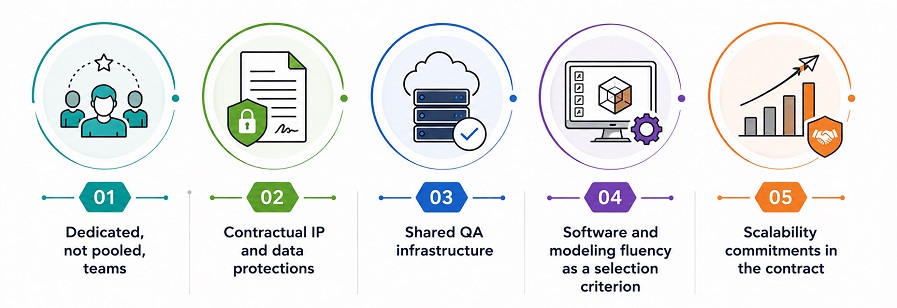
- Dedicated, not pooled, teams — a named group of detailers who learn your standards, your anchor library, your client base, rather than a rotating pool assigned project by project.
- Contractual IP and data protections — cast stone profiles, proprietary mix designs referenced in drawings, and client project data all need NDA and data-handling terms that a low-cost vendor relationship never bothered with.
- Shared QA infrastructure — standardized drawing templates, checklists, and revision tracking that live in the fabricator’s system, not the partner’s, so institutional knowledge doesn’t walk out the door if the partnership ends.
- Software and modeling fluency as a selection criterion, not an afterthought, can this partner work natively in your BIM environment, or are you exporting and re-importing files and losing coordination fidelity in the process?
- Scalability commitments in the contract — explicit terms for surge capacity (how fast can the team double?) rather than a vague promise.
The bottom line
The fabricators still shopping for the lowest offshore rate are competing in a market that’s already commoditized and shrinking in its cost advantage. The ones building real advantage are treating technical outsourcing the way a manufacturer treats a second production line: an asset that adds flexible capacity, specialized capability, and schedule resilience — priced not on the hour, but on what it lets the business say yes to.
“Cheap labor” was always a temporary strategy. Strategic capacity is a durable one.
If your team is managing larger projects, tighter schedules, or growing detailing demands, it may be time to rethink how your technical capacity is built.
Discover how Daiden Global helps manufacturers, contractors, and architects deliver fabrication-ready cast stone shop drawings that reduce coordination risks, accelerate approvals, and support BIM-driven project delivery.
Thank you for your reading. Join the conversation by posting a comment.