

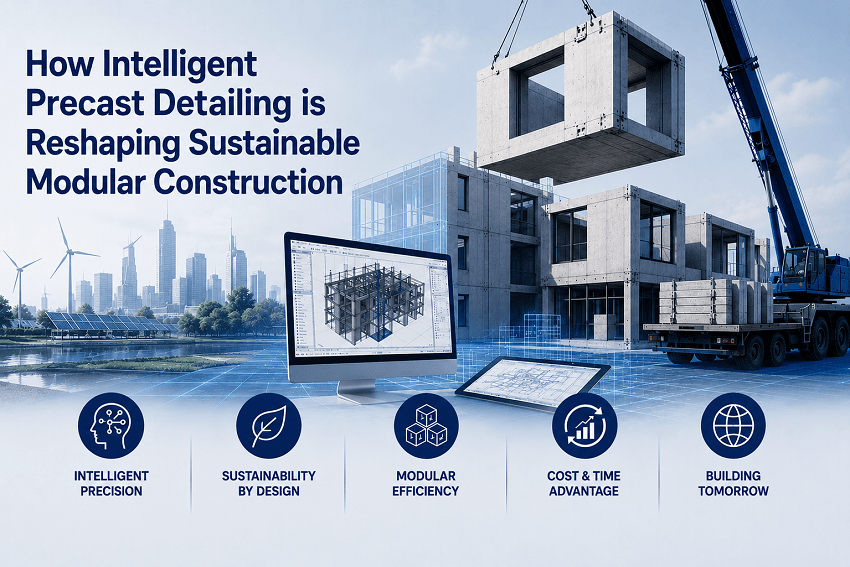
The construction industry is entering a phase where sustainability and efficiency are no longer separate objectives. Developers today are expected to deliver projects that are environmentally responsible, economically viable, and faster to execute. In response, modular construction and precast concrete systems have emerged as practical solutions for meeting these demands at scale.
However, the true transformation is not happening only in manufacturing plants or construction sites — it is happening in the detailing process itself.
Intelligent precast detailing has evolved into a highly strategic discipline that combines engineering precision, digital coordination, automation, and sustainability-focused design methodologies. More than just producing fabrication drawings, modern detailing workflows now influence material optimization, construction speed, carbon reduction, and long-term building performance.
As urban infrastructure grows more complex, intelligent detailing is becoming a foundational element of next-generation construction.
The Shift from Conventional Construction to Smart Manufacturing
Traditional construction methods often struggle with inefficiencies such as material waste, project delays, fragmented coordination, and inconsistent quality control. These challenges become even more critical as sustainability regulations tighten globally.
Precast construction addresses many of these limitations by transferring a significant portion of the building process into controlled manufacturing environments. Yet, the effectiveness of precast systems depends heavily on the quality and accuracy of the detailing process behind them.
Modern precast detailing enables:
- Precise coordination between structural, architectural, and MEP systems
- Fabrication-ready models with minimal site-level modifications
- Better resource planning through standardized production workflows
This manufacturing-oriented approach creates a more predictable construction ecosystem where errors are minimized before production even begins.
BIM as the Intelligence Layer of Precast Detailing
Building Information Modeling (BIM) has fundamentally changed how precast projects are designed and executed. Instead of isolated drafting workflows, BIM creates a centralized digital environment where all stakeholders collaborate in real time.
In intelligent precast detailing, BIM functions as more than a visualization tool. It becomes a decision-making platform that improves constructability, sequencing, and sustainability outcomes simultaneously.
Through BIM-enabled detailing, teams can identify structural conflicts early, optimize reinforcement layouts, and simulate installation procedures before fabrication starts. This level of coordination significantly reduces rework, which remains one of the largest sources of material and financial waste in construction projects.
More importantly, BIM-driven workflows support data-rich construction models that can integrate directly with fabrication machinery, procurement systems, and project management platforms.
Sustainability Begins at the Detailing Stage
Sustainable construction is often associated with green materials or energy-efficient buildings, but one of the most overlooked contributors to sustainability is design precision.
Intelligent precast detailing directly influences how efficiently materials are utilized throughout the project lifecycle. Accurate detailing reduces unnecessary concrete usage, avoids reinforcement conflicts, and improves production efficiency within precast manufacturing facilities.
This becomes especially important as the industry adopts low-carbon construction materials such as:
- Supplementary cementitious materials (SCMs)
- Recycled aggregates and engineered concrete mixes
- High-performance insulated precast panels
These advanced materials require precise engineering coordination to ensure structural integrity, thermal efficiency, and fabrication feasibility. Detailing teams therefore play a central role in translating sustainability goals into buildable solutions.
Automation is Redefining Precast Production
The integration of automation into precast manufacturing is rapidly transforming how construction components are produced. Intelligent detailing systems now generate machine-readable fabrication data that directly supports automated workflows.
Instead of relying solely on manual interpretation, manufacturers can use detailing outputs to drive CNC machines, robotic reinforcement systems, and automated mold preparation technologies.
This shift delivers several advantages:
- Higher dimensional accuracy during fabrication
- Reduced production waste and manual errors
- Faster project execution with improved consistency
Automation also enables scalable modular construction, where large volumes of standardized components can be produced efficiently without compromising quality.
As labor shortages continue affecting global construction markets, digitally integrated precast systems are becoming increasingly valuable for maintaining productivity and project reliability.
Energy Performance and Lifecycle Efficiency
Modern buildings are evaluated not only by how they are constructed, but also by how they perform over decades of operation. Intelligent precast detailing contributes significantly to long-term energy efficiency through advanced envelope design and thermal optimization.
Detailers now work closely with architects and energy consultants to develop systems that improve insulation performance, reduce thermal bridging, and support passive energy strategies.
This includes the integration of:
- Insulated sandwich wall systems
- Thermal break connections
- Ventilated façade assemblies
Because precast components are manufactured with high dimensional precision, buildings achieve better airtightness and thermal consistency compared to many traditional site-built systems.
The result is lower operational energy consumption and improved environmental performance throughout the building lifecycle.
The Growing Role of Modular Construction
Modular construction is accelerating globally because it aligns with the industry’s growing demand for speed, scalability, and sustainability. Intelligent precast detailing acts as the technical backbone of this construction model.
Unlike conventional projects where modifications often occur on-site, modular systems depend on exact dimensional coordination before manufacturing begins. Even minor detailing inaccuracies can disrupt transportation, assembly, and structural alignment.
Advanced detailing workflows ensure that modular components integrate seamlessly across structural, architectural, and service systems. This precision enables faster installation, reduced site disruption, and greater consistency across large-scale developments.
As cities continue facing pressure from rapid urbanization and infrastructure expansion, modular precast systems will likely become a dominant construction methodology in residential, healthcare, commercial, and industrial sectors.
The Future of Intelligent Precast Detailing
The next phase of precast detailing will be driven by connected technologies and predictive intelligence. Artificial intelligence is expected to automate repetitive detailing tasks while improving design optimization and material efficiency.
Digital twin technology may soon allow engineers and facility managers to monitor real-time structural performance using live building data. At the same time, IoT-enabled precast components could provide continuous insights into stress behavior, temperature variation, and maintenance conditions.
Cloud-based collaboration platforms will further strengthen coordination between globally distributed design teams, manufacturers, and contractors, creating faster and more integrated project delivery ecosystems.
In this evolving environment, precast detailing will move beyond technical documentation and become a core driver of intelligent construction strategy.
Conclusion
Intelligent precast detailing is no longer a supporting process within construction — it is becoming a central force behind sustainable and modular building innovation.
By combining BIM-driven coordination, automation, precision engineering, and sustainability-focused design, modern detailing workflows are helping the construction industry reduce waste, improve efficiency, and deliver higher-performing buildings.
As the industry continues shifting toward smarter and greener infrastructure, organizations that invest in advanced precast detailing capabilities will be better positioned to lead the future of construction.
Thank you for your reading. Join the conversation by posting a comment.