

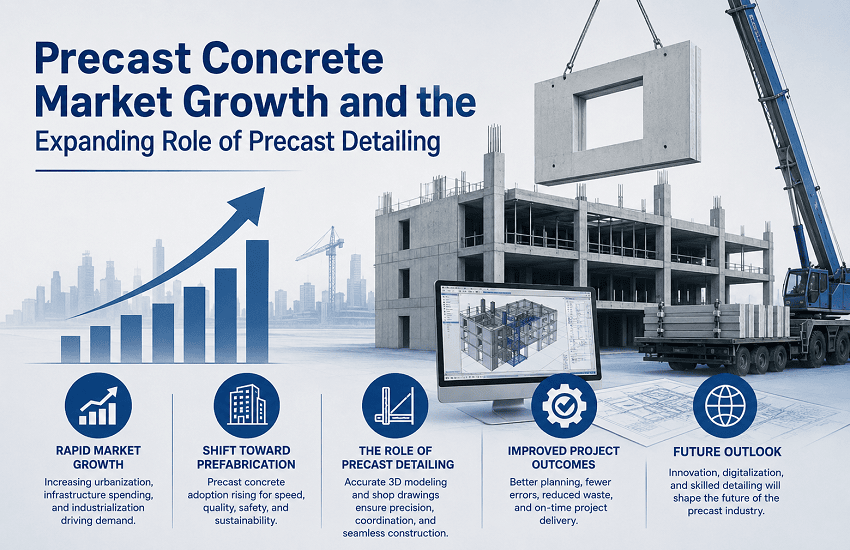
The global precast concrete market is witnessing significant growth as the construction industry increasingly adopts faster, more efficient, and sustainable building methods. Precast concrete, manufactured in controlled factory environments and assembled on-site, has become a preferred construction solution across residential, commercial, and infrastructure sectors. Alongside this growth, precast detailing is emerging as a critical component that ensures structural accuracy, installation efficiency, and project coordination.
As modern construction projects become more complex and time-sensitive, the integration of advanced precast detailing with modular construction systems is transforming how buildings and infrastructure are designed, manufactured, and assembled.
Growing Demand for Modular and Rapid Construction
One of the primary factors driving the growth of the precast concrete market is the increasing demand for modular and off-site construction. Developers are seeking construction methods that reduce project timelines while maintaining quality and minimizing labor dependency.
Precast walls, slabs, beams, staircases, and structural panels are manufactured before arriving at the construction site, allowing immediate installation without major weather-related delays. This approach significantly improves construction speed and project predictability.
Precast detailing plays a crucial role in this process. Detailed engineering drawings and 3D modeling ensure that every component is manufactured with precise dimensions, reinforcement layouts, embedded elements, and connection systems. Accurate detailing reduces on-site errors, improves assembly coordination, and enables seamless integration between architectural and structural elements.
The ability to achieve faster construction with improved quality control makes precast systems highly attractive for residential housing, commercial buildings, industrial facilities, and institutional projects.
Infrastructure Modernization Accelerating Market Expansion
Governments worldwide are investing heavily in infrastructure modernization, including highways, bridges, rail networks, airports, tunnels, metro systems, and smart cities. These projects require durable and standardized construction systems capable of delivering long-term performance with minimal maintenance.
Precast concrete has become increasingly important in infrastructure development because of its structural reliability, dimensional consistency, and rapid installation capabilities. Components such as bridge girders, retaining walls, tunnel segments, drainage systems, and railway sleepers are widely produced using precast methods.
Precast detailing is essential in infrastructure projects because it ensures engineering precision and structural compatibility. Detailed connection designs, lifting arrangements, reinforcement coordination, and erection sequencing are necessary to ensure safe transportation and installation of large precast elements.
Advanced detailing software and Building Information Modeling (BIM) technologies now enable engineers and manufacturers to improve collaboration, reduce clashes, and streamline construction workflows across large-scale infrastructure projects.
Sustainability and Green Building Requirements
Sustainability is another major force driving demand in the precast concrete market. Developers, governments, and regulatory authorities are increasingly prioritizing environmentally responsible construction solutions that reduce waste, improve energy efficiency, and lower carbon emissions.
Precast concrete supports sustainable construction in several ways:
- Reduced material waste through controlled factory production
- Lower on-site pollution and noise
- Improved quality control and material optimization
- Enhanced thermal performance for energy-efficient buildings
- Longer structural life cycles with lower maintenance requirements
Precast detailing further contributes to sustainability by optimizing material usage and reducing manufacturing errors. Accurate detailing minimizes rework, prevents unnecessary material consumption, and ensures efficient reinforcement placement and connection design.
As green building certifications and energy efficiency standards become more widespread, precast concrete systems integrated with advanced detailing solutions are becoming increasingly valuable in modern construction.
The Expanding Role of Precast Detailing
As the precast industry grows, precast detailing services is evolving from a supporting engineering function into a strategic project requirement. Modern precast detailing involves the preparation of highly detailed fabrication and erection drawings that guide manufacturing, transportation, and installation processes.
Precast detailers are responsible for:
- Structural shop drawings
- Reinforcement detailing
- Connection detailing
- Embedment and insert coordination
- Panel layouts and assembly sequencing
- Erection planning
- BIM integration and clash detection
The increasing complexity of construction projects has elevated the importance of detailed coordination between architects, structural engineers, contractors, and manufacturers. Accurate precast detailing ensures that components fit precisely during installation, reducing delays and improving overall project efficiency.
Digital tools such as Tekla Structures, AutoCAD, Revit, and BIM-based workflows are revolutionizing the detailing process by enabling real-time collaboration and improved design accuracy.
Technological Advancements Driving Industry Transformation
Technological innovation is further accelerating growth across both the precast manufacturing and detailing sectors. Automated production systems, robotic reinforcement placement, digital fabrication, and BIM-based project management are improving efficiency throughout the construction lifecycle.
Modern precast facilities are increasingly integrating smart manufacturing technologies that allow:
- Faster production cycles
- Improved dimensional accuracy
- Reduced labor dependency
- Enhanced quality assurance
- Better project tracking and coordination
At the same time, advanced detailing technologies are enabling greater design flexibility and customization. Engineers can now model complex geometries, analyze structural connections, and optimize installation sequencing with greater precision than ever before.
This technological integration is helping transform precast concrete from a traditional construction material into a comprehensive industrialized building system.
Challenges Affecting Market Growth
Despite strong growth potential, the precast concrete market faces several operational and economic challenges.
Transportation and Logistics Constraints
Precast components are large and heavy, requiring specialized transportation and lifting equipment. Delivery logistics can become expensive and complicated, particularly in remote locations or urban areas with restricted site access.
Improper coordination between manufacturing and detailing can also create transportation and installation difficulties, making precise planning essential.
High Initial Capital Investment
Setting up a precast manufacturing facility requires substantial investment in molds, machinery, automation systems, transportation infrastructure, and quality control systems. Small and medium-sized manufacturers may face barriers to market entry due to these high capital requirements.
Similarly, advanced precast detailing demands skilled professionals and specialized software, which can increase operational costs for companies transitioning toward digital construction practices.
Future Opportunities in the Precast Concrete Industry
The future of the precast concrete market remains highly promising due to increasing urbanization, infrastructure development, modular construction adoption, and sustainability requirements.
The market is projected to grow from USD 150.2 billion in 2025 to USD 261.5 billion by 2035 at a CAGR of 5.7%, reflecting strong global demand for efficient and durable construction solutions.
Key growth opportunities include:
- Expansion of modular housing projects
- Smart city and infrastructure development
- Increased adoption of BIM and digital detailing
- Sustainable and energy-efficient building construction
- Industrialized and automated construction methods
- Growing demand for precision-engineered structural systems
Asia Pacific is expected to remain a major growth region due to rapid urbanization and large-scale infrastructure investments. Wall products currently dominate the market with a 34.8% share, while residential applications account for approximately 37.0% of total market demand.
Conclusion
The precast concrete market is expanding rapidly because it addresses critical construction industry needs such as speed, quality, sustainability, and cost efficiency. At the same time, precast detailing is becoming increasingly important in ensuring precision, coordination, and successful project execution.
As construction projects become more technologically advanced and structurally complex, the integration of precast manufacturing with intelligent detailing systems will play a vital role in shaping the future of modern construction. Companies that combine high-quality precast production with advanced detailing capabilities will be better positioned to meet the growing global demand for faster, smarter, and more sustainable building solutions.
Thank you for your reading. Join the conversation by posting a comment.